SAMS Odisha: New SEBC Quota & Subject Rules
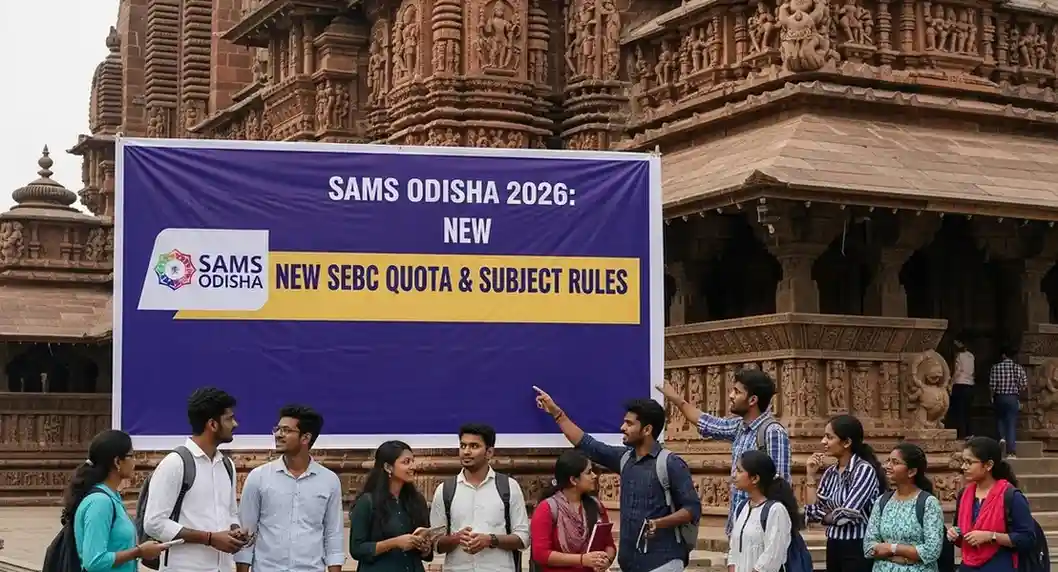
Honestly, if you’re a student in Odisha trying to figure out college admissions for 2026-27 — you’re not alone in feeling confused. Indeed, this year presents significant changes. The 11.25% SEBC quota is now fully in place, and thanks to NEP 2020, the subject combination rules have been reshuffled too. So yeah, it’s a bit more structured than before, which sounds reassuring on paper but can feel overwhelming when you’re the one filling out the form.
I put this guide together because I kept seeing the same questions being asked over and over — and most answers were either too vague or buried in official jargon nobody has time to decode. So let’s just talk through it clearly, like one person explaining it to another.
Reservation Update: 11.25% SEBC Implementation
Odisha has officially integrated an 11.25% vertical reservation for Socially and Educationally Backward Classes (SEBC) across all state-funded institutions. This move brings the total vertical reservation to the 50% legal ceiling, ensuring equitable access to higher education.
Revised Seat Distribution Matrix
The seat matrix follows a uniform distribution across all streams:
- Scheduled Tribe (ST): 22.5%
- Scheduled Caste (SC): 16.25%
- SEBC (New): 11.25%
- Unreserved (UR): 50%
Departmental Coverage
The new quota is mandatory for all government and aided institutions under:
- SME: School & Mass Education (+2 Higher Secondary).
- Higher Education: Degree (+3), Universities, and Teacher Education.
- SDTE: ITI, Diploma, and Professional Engineering courses.
- Health & Family Welfare: Medical, Nursing, and Pharmacy admissions.
Vertical vs. Horizontal Reservation
While SC, ST, and SEBC are vertical (social) categories, PwD (5%) and ex-servicemen (1%) are horizontal. This means a PwD candidate from the SEBC category will occupy a seat within the 11.25% SEBC quota, not a separate pool.
Document Standards for SEBC Applicants
Accuracy in documentation is the primary reason for application rejection. For 2026, the SAMS portal uses automated verification.
- Caste Certificate Requirements: Only digital certificates issued by a Tahasildar or Additional Tahasildar are valid. Ensure your certificate is updated in the e-District portal.
- The Non-Creamy Layer (NCL) Clause: To claim SEBC benefits, your family’s annual income (excluding agriculture and salary for specific cadres) must be below ₹8 Lakh. Certificates must be issued within the last three financial years to remain valid for 2026.
- Aadhaar-Linked Authentication: Your mobile number must be linked to your Aadhaar. SAMS 2026 uses e-KYC to fetch your identity details directly, reducing manual entry errors.
Subject Mapping Under NEP 2020: Major & Minor Rules
The traditional “Honors” system is replaced by a credit-based major/minor framework.
- Selecting Your Primary Major: Students choose one Major (e.g., physics), which carries the highest credit weightage. You must meet the specific subject-wise cut-off for your chosen Major.
- Double-Major Eligibility: High-performing students (typically those with an SGPA above 7.5 in the first year) may opt for a second Major, allowing for interdisciplinary specialization.
- Automated Allotment Logic: The SAMS algorithm processes your College + Subject preference list. If you don’t secure your 1st choice, you are automatically considered for your 2nd or 3rd preference based on merit.
Common Application Form (CAF)
- New Student Registration: Visit
samsodisha.gov.in, enter your name and mobile number, and verify via OTP. - Category & Weightage: Select SEBC carefully. Mistakenly selecting “General” cannot be reverted after the payment phase.
- DigiLocker Integration: Use the “Fetch Documents” button to sync your 10th and 12th marks directly from DigiLocker to ensure 100% data accuracy.
- Payment & Confirmation: Complete the fee payment (General/SEBC: ~₹300, SC/ST: ~₹200) and download the Applicant Copy for physical verification.
SAMS Odisha: Admission Timeline & Spot Selection Guide
The new admission cycle follows a strict automated schedule. Missing a deadline often results in a permanent “seat forfeiture” for the session.
Key Dates for CAF Submission
- Online CAF Release: Last week of May 2026.
- Submission Deadline: Last week of June 2026.
- 1st Selection Merit List: July 7, 2026 (Expected).
Managing Seat Allotment: Freeze vs. Slide-Up
Upon selection, you must log in to your Student e-Space to exercise one of two choices:
- Freeze: You are satisfied with the college. Pay the admission fee and download the Intimation Letter.
- Slide-Up: You accept the seat but want a higher-preference college from your CAF. You must take admission in the current college first to remain eligible for upward movement.
Error Correction & Spot Admission
So here’s something a lot of students miss — after the deadline, there’s actually a small 48-hour window where you can still go back and fix certain things. Have you made a typo in your mobile number? Do you have your marks wrong? You can correct those. But just so you know, category changes are off the table during this window, so don’t wait around hoping to switch that.
Now if the main admission rounds go by and you still didn’t get selected—don’t panic yet. There’s still Spot Admission happening in August 2026, and honestly, more people get through this route than you’d think. The SEBC quota still applies here too, just on whatever seats are still vacant at that point. The catch is you’ll need to do a fresh “choice locking” — meaning you go in again, check the real-time vacancy reports, and resubmit based on what’s actually available. For that, you’ll need to head to your nearest Nodal SAMS resource center in person.
Yeah, it’s a bit of an extra step. But if you stay on top of the dates and don’t assume it’s over after round one, you’ve still got a real shot.
Read Also Fix SAMS Odisha Login: OTP Not Received Solutions ➔